SSNIT Contributions in Ghana 2026: How Much Is Deducted, How to Check Your Balance and Claim
SSNIT deducts 18.5% of your basic salary in Ghana: 5.5% from you, 13% from your employer. How to check your balance and claim, as of October 2026.

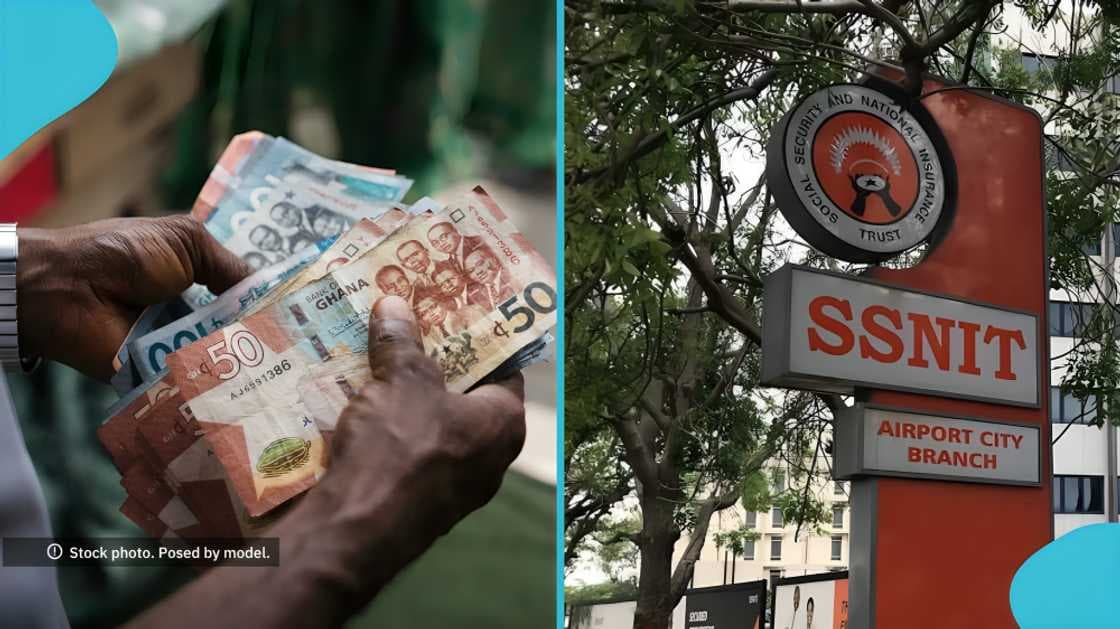
In this guide▾
- Quick facts
- How much does SSNIT actually deduct from your salary?
- Who has to contribute to SSNIT?
- When should your SSNIT contribution be paid, and what happens if it's late?
- How do you check your SSNIT contributions or balance?
- How do you check your SSNIT number on your phone?
- How many months must you contribute to get an SSNIT pension?
- How do you claim an SSNIT pension or benefit?
- What's changing with SSNIT in 2026?
- What to watch out for
- Frequently asked questions
SSNIT takes 18.5% of your basic salary every month in Ghana, as of October 2026: you pay 5.5% and your employer adds the other 13% on top of your pay, not out of it. Of that 18.5%, 13.5% goes to SSNIT itself (your Tier 1 pension) and 5% goes to a separate, privately managed Tier 2 fund. You can check exactly what's been paid in by dialling *711*9# on any network, or logging into the SSNIT self-service portal — no need to wait for your employer's word for it. To see how that 5.5% feeds into your PAYE and final take-home pay, run your basic salary through our Ghana PAYE calculator.
Quick facts
| Total contribution | 18.5% of basic salary |
| You pay | 5.5% (deducted from your pay) |
| Your employer pays | 13% (on top, not deducted) |
| Goes to SSNIT (Tier 1) | 13.5% of basic salary |
| Goes to Tier 2 (private trustee) | 5% of basic salary |
| Employer's payment deadline | Within 14 days of the following month |
| Check your balance by USSD | *711*9# (any network) |
| Minimum contribution for a monthly pension | 180 months (15 years) under Act 766 |
| 2026 minimum monthly contribution | GH₵79.40 |
| 2026 maximum monthly contribution | GH₵9,315.00 |
How much does SSNIT actually deduct from your salary?
Say you're Esi, a bank teller in Takoradi on a basic salary of GH₵2,500 a month. Here's where your 18.5% goes, based on SSNIT's own contribution guide:
| Rate | Amount on GH₵2,500 | |
|---|---|---|
| Your deduction | 5.5% | GH₵137.50 |
| Employer's addition | 13% | GH₵325.00 |
| Total contribution | 18.5% | GH₵462.50 |
| → to SSNIT (Tier 1) | 13.5% | GH₵337.50 |
| → to Tier 2 occupational scheme | 5% | GH₵125.00 |
Only your 5.5% comes off your payslip; the employer's 13% is an extra cost to them, not a deduction from you. Your employer is supposed to register you and remit both shares every month — the deduction on your payslip means nothing if it isn't actually paid over, which is why it's worth checking your own statement rather than trusting the payslip line alone.
One detail most people miss: of the 13.5% that goes to SSNIT, SSNIT only keeps 11% for your pension — the remaining 2.5% is passed on to the National Health Insurance Authority (NHIA) as a levy, according to SSNIT's contribution brochure. That's part of why formal-sector workers don't pay NHIS premiums directly — it's already coming out of your SSNIT contribution.
Who has to contribute to SSNIT?
Any employer in Ghana with at least one worker — Ghanaian or foreign — must register with SSNIT and register that worker, per SSNIT's own guidance for employers. There's no small-business exemption. New employers must register within 30 days of starting operations, and workers generally join the scheme between the ages of 15 and 45. If you haven't registered your business itself yet, that comes first — see our guide to registering a business in Ghana for the ORC steps and fees.
If you're self-employed — running a shop, a trotro, a salon, freelancing — joining SSNIT is voluntary, but there's a route for it. Self-employed contributors pay the full 13.5% themselves (since there's no employer to add the other share), calculated on whatever monthly income you declare. SSNIT runs outreach for informal-sector workers under what it's sometimes called the Self-Employed Enrolment Drive; the fastest way to join is to visit your nearest SSNIT branch with your Ghana Card.
When should your SSNIT contribution be paid, and what happens if it's late?
Employers must remit contributions to SSNIT within 14 days of the end of the month they're deducted for, along with a monthly contribution report — filed whether or not the money has actually been paid. Miss that, and after a written demand notice, SSNIT's brochure sets out a penalty of 3% on the outstanding amount.
That penalty is on the employer, but it's your pension record that suffers if they don't pay. The only way to know for sure is to check your own statement rather than assume the deduction on your payslip has actually reached SSNIT.
How do you check your SSNIT contributions or balance?
Three ways, none of which need you to go through your employer:
- USSD (works without data): Dial
*711*9#on any Ghanaian network and follow the prompts to check an abridged version of your statement of account. - SSNIT self-service portal: Go to portal.ssnit.org.gh, or click "Self Service" on ssnit.org.gh. First time there, request a Portal ID, fill in the request form and answer the security questions — a temporary password is emailed to you, and you log in and change it. Once in, select "Contribution" to see your full Statement of Account.
- SSNIT mobile app: available on the App Store, Google Play and Huawei AppGallery.
If you've registered an email address with SSNIT, you should also get a statement sent automatically every quarter — if you've never seen one, your email on file is probably out of date.
How do you check your SSNIT number on your phone?
If you've linked your SSNIT number to your Ghana Card already, dial *711*9#, choose Member Services, then select the option to check your merger status rather than merge afresh — enter your SSNIT number or your Ghana Card (NIA) number when prompted, and your status is sent to your registered email. You can also do this on ssnit.org.gh under "My Statement," where there's a box to check whether your Ghana Card is linked.
If you genuinely don't have either number to hand, USSD and the portal won't help — your most reliable option is to visit the nearest SSNIT branch in person with your Ghana Card, which staff will use to pull up or re-link your record.
How many months must you contribute to get an SSNIT pension?
You need at least 180 months — 15 years — of contributions under the current law (Act 766) to qualify for a monthly pension, whether you're taking the full pension at 60 or a reduced pension between 55 and 59, per SSNIT's old age benefit rules. Members still under the older PNDC Law 247 need 240 months instead.
Hitting exactly 180 months gives you a minimum pension right of 37.5% of your average earnings. Every extra year you contribute beyond that adds 1.125 percentage points, up to a cap of 60% once you've contributed 420 months — 35 years.
Fall short of 180 months and you're not left with nothing: at 55 or older, you instead get a one-off Old Age Lump Sum rather than a monthly pension.
How do you claim an SSNIT pension or benefit?
- Old age pension: visit a SSNIT branch with your Ghana Card number, your retirement or exit letter from your employer, and your bank account details, then complete the application form there. SSNIT also offers a free online pension calculator on its site if you want to estimate your pension before you apply.
- Survivors' lump sum (for a deceased member's dependants): report the death at the nearest branch with at least one piece of evidence — a death certificate, a medical certificate of cause of death, letters of administration, or similar — plus photo ID and bank details for the beneficiaries. The deceased needs to have contributed at least 12 of the last 36 months, or have been a pensioner who died before 75.
- Invalidity pension: needs at least 12 months of contributions in the last 36 months, a medical report, and sign-off from SSNIT's own Medical Board confirming you can no longer do gainful work.
- Emigration lump sum (non-Ghanaians leaving permanently): a branch visit with an employer's letter confirming emigration, your passport, and permit copies.
SSNIT doesn't publish a guaranteed payout timeline for any of these on its site, so treat "how long will it take" as a question for your branch once you've applied, not something you can plan around in advance.
What's changing with SSNIT in 2026?
From 1 January 2026, SSNIT raised the maximum insurable earnings from GH₵61,000 to GH₵69,000 a year and the minimum from GH₵539.19 to GH₵587.80, in line with the new National Daily Minimum Wage — SSNIT's own public notice puts the resulting monthly contribution ceiling at GH₵9,315.00 and the floor at GH₵79.40. If your basic salary is above GH₵69,000 a year, your SSNIT contribution is capped at that ceiling regardless of how much more you earn.
Pensioners also got an increase this year: SSNIT approved a roughly 10% rise in monthly pensions for 2026, weighted to help lower-income pensioners more, according to Citi Newsroom's report on SSNIT's announcement — worth checking your own payment against if you're already drawing a pension. Being an active SSNIT contributor or pensioner also means you don't pay the NHIS premium — see how to register for or renew your NHIS cover for free.
What to watch out for
- Trusting the payslip, not the statement. A deduction on your payslip proves nothing about whether your employer actually paid it over. Check your SSNIT statement by USSD or the portal every few months, especially if you've changed jobs recently.
- Anyone asking for money to "release" your pension or merge your numbers faster. SSNIT's own channels — the branch, the portal, the app,
*711*9#— don't charge you for any of this. Treat anyone demanding a fee to speed up a claim as a scam. - Assuming Tier 2 is the same as SSNIT. Your 5% Tier 2 contribution sits with a separate, privately managed trustee, not SSNIT. If you want to know your Tier 2 balance, you'll need to ask that trustee directly — SSNIT's portal only shows your Tier 1 record.
- Letting your SSNIT and Ghana Card numbers stay unmerged. If they're not linked, your statement and future claims can get delayed. It only takes a few minutes by USSD to check and fix.
If you're also sorting out your PAYE or your TIN this year, your SSNIT number usually gets tidied up at the same time — most of this runs off the same Ghana Card, so it's worth getting a Ghana Card sorted first if you don't have one yet. Once your mandatory pension contributions are settled, some people also look at government bonds in Ghana or a compound interest calculator to work out what topping up their own savings on the side could grow into. For more on tax, saving and pensions where you are, see our other Ghana money guides.
Frequently asked questions
What percentage of my salary goes to SSNIT in Ghana?
18.5% of your basic salary in total: 5.5% deducted from your pay, and 13% added by your employer on top. Of that 18.5%, 13.5% goes to SSNIT itself and 5% goes to a separate Tier 2 scheme.
How do I check my SSNIT balance from my phone?
Dial *711*9# on any network — it works without internet data — and follow the prompts to see an abridged statement of account. For the full statement, log into the SSNIT self-service portal at portal.ssnit.org.gh or use the SSNIT mobile app.
What is the SSNIT USSD code?
*711*9#. It lets you check an abridged statement of account, check or merge your SSNIT and Ghana Card numbers, and (if you're self-employed) pay your contribution by mobile money.
How many years do I need to contribute to get a full SSNIT pension?
15 years, or 180 months, under the current law (Act 766) — for either the full pension at 60 or a reduced pension from 55. Older members still under PNDC Law 247 need 20 years (240 months) instead.
Can self-employed people in Ghana contribute to SSNIT?
Yes, voluntarily. You pay the full 13.5% yourself, calculated on whatever monthly income you declare, since there's no employer to add the other share. Register at your nearest SSNIT branch with your Ghana Card.
What happens if my employer doesn't pay my SSNIT contributions?
The deduction on your payslip isn't proof the money reached SSNIT. Check your own statement by USSD or the portal — if contributions are missing, raise it with your employer and, if that doesn't work, report it to your nearest SSNIT branch, since it's your pension record and eventual payout that's affected, not just a compliance issue for the company.
Keep reading

PAYE in Ghana 2026: Tax Bands, SSNIT and What You Take Home
How to calculate PAYE in Ghana for 2026: the GRA's tax bands, the 5.5% SSNIT deduction, and real take-home pay examples in GH₵, checked October 2026.
4 Oct 2026 · 8 min read
How to Check Your TIN Number in Ghana
Your TIN in Ghana is the PIN on your Ghana Card, official since April 2021. How to check it fast, verify it online with GRA, and link an old TIN, October 2026.
28 Sept 2026 · 7 min read

How Much Does a Ghana Card Cost in 2026? Full NIA Fee Guide
What a Ghana Card costs in 2026: GH¢30 for first-time registration if you're 25+, GH¢200 to replace a lost card, plus Premium and Prime Time fees.
26 Sept 2026 · 7 min read