How Much Does a Ghana Card Cost in 2026? Full NIA Fee Guide
What a Ghana Card costs in 2026: GH¢30 for first-time registration if you're 25+, GH¢200 to replace a lost card, plus Premium and Prime Time fees.

In this guide▾
- Ghana Card fees at a glance (district office)
- Why the fees went up in 2026
- What you need to register for a Ghana Card
- How much does it cost to replace a lost or damaged Ghana Card?
- Premium Centre and Prime Time (24-hour) fees
- What it costs foreigners to get a Ghana Card
- What to watch out for
- Frequently asked questions
A first-time Ghana Card at a National Identification Authority (NIA) district office costs GH¢30 if you're 25 or older, and it's free if you're under 25. Replacing a lost, stolen or damaged card costs GH¢200 at a district office, GH¢520 at a Premium Centre, or GH¢720 at the express "Prime Time" service. These are the NIA's approved fees, which took effect on 2 February 2026 and are current as of September 2026. Foreigners living in Ghana pay in US dollars, and updating your details without needing a new card printed is usually free.
Ghana Card fees at a glance (district office)
Most people register or renew at a standard NIA district or regional office, so these are the fees that matter for almost everyone.
| Service | District office fee |
|---|---|
| First-time registration (under 25) | Free |
| First-time registration (25 and older) | GH¢30 |
| Card replacement (lost, stolen or damaged) | GH¢200 |
| Card renewal | GH¢150 |
| Record update only, no new card printed | Free |
| Record update with a new card printed | GH¢200 |
| Nationality record update | GH¢200 |
| Card transfer (change of registration centre) | GH¢75 |
Source: NIA Approved Fees and Charges, effective 2 February 2026, checked September 2026.
Why the fees went up in 2026
The NIA raised these charges under the Fees and Charges (Miscellaneous Provisions) (Amendment) Regulations, 2025, after Parliament approved the revision. It's the first change since 2023. The authority says operating costs — technology licensing, cybersecurity, utilities, logistics and staffing — have climbed steadily since then without a matching fee adjustment. First-time registration for anyone under 25 stays free either way.
What you need to register for a Ghana Card
You'll need one of these to prove your identity and citizenship:
- Birth certificate from Ghana's Births and Deaths Registry
- Valid Ghana passport
- An Oath of Identity form, if someone vouches for you
- Evidence of acquired citizenship (naturalisation or registration certificate)
- A Digital Address (GhanaPostGPS) code for where you live
Bring an SSNIT ID, Tax Identification Number (this becomes your Ghana Card PIN once the card is issued), driver's licence, voter ID or NHIS card too if you have one — it speeds up verification, though it isn't compulsory.
That PIN is also what your employer uses to report your pay to the GRA once you're working, so it's worth having correctly registered before your first payday — see our guide to how PAYE is calculated in Ghana for how it feeds into your payslip.
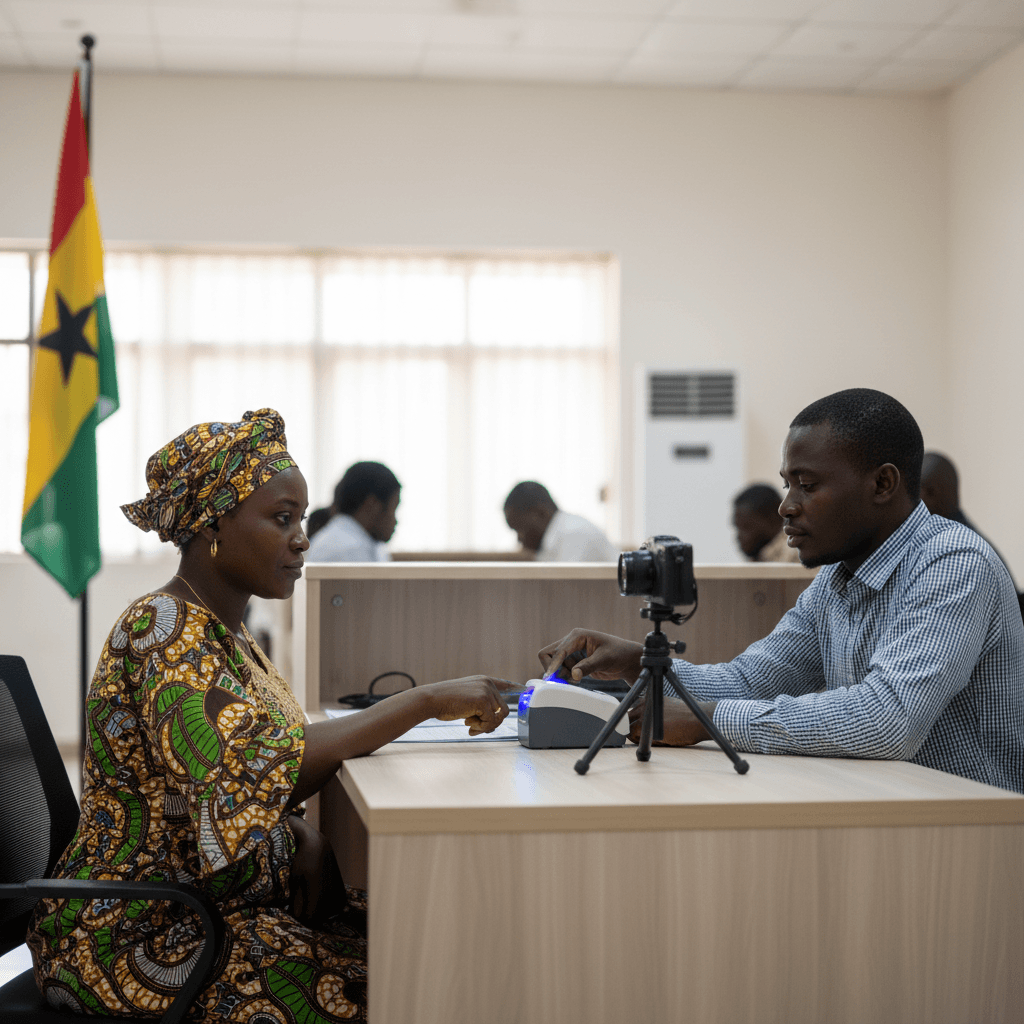
Registration itself runs in five steps at the centre: an interview and application form, biometric capture (fingerprints, iris scan, photo and signature), a review of your printed details, and finally printing and issuing the card. For people aged 15 and over at centres with reliable power and data, the NIA says the card can be issued on the spot. Where connectivity is a problem, or for children under 15, issuing is deferred until data has been captured and the card printed centrally.
How much does it cost to replace a lost or damaged Ghana Card?
A straightforward replacement at a district office is GH¢200. You can't just walk in and pay, though — the NIA's replacement process requires:
- An original Police Extract from the Ghana Police Service (photocopies aren't accepted) if the card is lost or stolen.
- Your damaged or defaced card, if that's the reason you're replacing it.
- A completed electronic request form at the registration office.
- Approval from an NIA approval officer.
- Payment — either at CalBank or by dialling the USSD code *771# — and surrender of the old card if you still have it.
- A fresh round of biometric capture before the new card is issued.
Skip the police extract and the office will turn you away, so get that sorted first if your card was lost or stolen.
Premium Centre and Prime Time (24-hour) fees
If you don't want to wait in the queue at a district office, the NIA runs two faster, paid tiers in its approved fee schedule. Using either is optional — the NIA has said so explicitly.
Premium Centres
| Service | Fee |
|---|---|
| First-time registration | GH¢410 |
| Card renewal | GH¢410 |
| Card replacement | GH¢520 |
| Record update, no new card | GH¢165 |
| Record update with new card | GH¢410 |
| Nationality update | GH¢410 |
Prime Time service (marketed as the 24-Hour Prestige Centre in Labone, Accra, which opened 1 August 2026 and runs around the clock, seven days a week)
| Service | Fee |
|---|---|
| First-time registration | GH¢610 |
| Card renewal | GH¢610 |
| Card replacement | GH¢720 |
| Record update, no new card | GH¢400 |
| Record update with new card | GH¢655 |
| Nationality update | GH¢655 |
This tier is currently the only one of its kind, so it's worth it mainly if you're in or near Accra and genuinely need a card outside normal office hours — say, before an early flight or a deadline you can't move.
What it costs foreigners to get a Ghana Card
Foreign nationals living in Ghana register under the Foreigner Identification Management System (FIMS), and the fees are set in US dollars, paid in cedi equivalent on the day:
| Service | Fee |
|---|---|
| First registration | US$120 (about GH¢1,392) |
| Annual renewal | US$78 (about GH¢905) |
| Card replacement | US$78 (about GH¢905) |
| Records update only | Free |
The cedi figures are rough — the NIA converts at that day's rate, and the ones here use the mid-market rate of roughly GH¢11.60 to US$1 in late September 2026, so expect them to move.
Ghanaians registering or replacing a card through a Ghana mission abroad instead pay by region: about US$55 in the ECOWAS region, US$75 elsewhere in Africa, and US$115 outside Africa.
Every Ghanaian adult needs a Ghana Card for practically anything involving money in the country now — opening a bank account, registering a SIM, investing, registering a business, checking your SSNIT contributions, or registering for NHIS, since your card PIN is what SSNIT uses to confirm who you are. If you're weighing up where to put your savings once your card is sorted, our guide to buying government bonds in Ghana walks through the account-opening steps, which start with the same card.
What to watch out for
- Only pay through official channels. CalBank or the USSD code *771# are the routes the NIA names for replacement payments. Anyone at a registration centre asking for cash "to speed things up" is not an NIA charge — it's a bribe, and you should report it.
- Originals only for a police extract. A photocopy will get your replacement request rejected on the spot, so budget the time to get to a police station first.
- Registering abroad goes through a Ghana mission, not a local agent. If someone outside an embassy or high commission offers to register you for a fee, that's not a legitimate NIA channel.
- The paid tiers are optional, not compulsory. If an agent tells you the district office "isn't taking registrations" and only the Premium or Prime Time centre is open, verify with the NIA directly (0302 999 306) before paying triple the price.
For more on managing money day to day once your paperwork is sorted, see our Ghana hub and the wider personal finance guides on SwiftPesa. Once your card is in hand, it's also the ID most banks and brokers ask for if you want to buy a Treasury bill.
Frequently asked questions
Is the Ghana Card free?
First-time registration is free if you're under 25. If you're 25 or older, it's GH¢30 at a district office. Replacing a card, renewing one, or updating your nationality always costs something — only a plain record update with no new card printed is free.
How much does it cost to replace a lost Ghana Card?
GH¢200 at a district office, effective 2 February 2026. You'll need an original Police Extract before the office will process the request — a photocopy isn't accepted.
How much is a Ghana Card for foreigners?
Foreign residents pay under the Foreigner Identification Management System: US$120 for first registration and US$78 for annual renewal or replacement, paid in cedis at that day's rate — roughly GH¢1,392 and GH¢905 as of September 2026.
What's the difference between a district office, a Premium Centre and the Prime Time service?
District offices are the cheapest and standard route. Premium Centres cost more but usually move faster. The Prime Time service, marketed as the 24-Hour Prestige Centre in Labone, Accra, is the priciest option, open around the clock every day, and useful mainly if you need a card outside normal hours.
Can I update my Ghana Card details for free?
Yes, if you don't need a new physical card printed — a plain record update at a district office is free. If the update means a new card, it's GH¢200 at a district office.
Do Ghanaians registering abroad pay a different fee?
Yes. Registration or replacement through a Ghana mission costs about US$55 in the ECOWAS region, US$75 in the rest of Africa, and US$115 outside Africa.
Keep reading
SSNIT Contributions in Ghana 2026: How Much Is Deducted, How to Check Your Balance and Claim
SSNIT deducts 18.5% of your basic salary in Ghana: 5.5% from you, 13% from your employer. How to check your balance and claim, as of October 2026.
7 Oct 2026 · 9 min read

PAYE in Ghana 2026: Tax Bands, SSNIT and What You Take Home
How to calculate PAYE in Ghana for 2026: the GRA's tax bands, the 5.5% SSNIT deduction, and real take-home pay examples in GH₵, checked October 2026.
4 Oct 2026 · 8 min read
How to Check Your TIN Number in Ghana
Your TIN in Ghana is the PIN on your Ghana Card, official since April 2021. How to check it fast, verify it online with GRA, and link an old TIN, October 2026.
28 Sept 2026 · 7 min read