Mobile money agent business in Uganda is at the heart of its financial system. From paying school fees to buying groceries and sending money upcountry, services like MTN Mobile Money, Airtel Money, and M-Pesa dominate daily transactions.
According to Bank of Uganda, over 30 million Ugandans actively use mobile money, making it the most accessible financial service in the country.
For entrepreneurs, starting a mobile money agent business in Uganda is a proven way to generate consistent income. With relatively low startup costs, high transaction volumes, and reliable commissions, this venture offers stability and scalability.
Why Start Mobile Money Agent Business in Uganda
- High Demand: Over 80% of Ugandan adults use mobile money for payments, savings, and transfers.
- Steady Income: Agents earn commissions on every cash-in, cash-out, bill payment, or airtime sale.
- Low Capital Requirement: Compared to retail shops, the business requires modest investment.
- Scalable Model: You can start with one booth and expand to multiple outlets in different locations.
👉 Related reading: Best Agribusiness Investments in Africa for Young Entrepreneurs
Step-by-Step Guide to Starting a Mobile Money Agent Business in Uganda
1. Market Research
- Survey neighborhoods for population density, commercial activity, and existing agent presence.
- Choose areas with high foot traffic: near markets, bus parks, schools, and trading centers.
- Analyze which provider (MTN, Airtel, M-Pesa) dominates in your area to decide on priority partnerships.
2. Licensing and Registration
- Apply to become an agent with MTN Uganda, Airtel Uganda, or Safaricom M-Pesa (via Vodacom Tanzania for cross-border agents).
- Requirements usually include:
- Business registration certificate from the Uganda Registration Services Bureau (URSB)
- Valid trading license from your local authority
- National ID or incorporation documents
- Startup capital (float) — usually UGX 2–5 million minimum depending on provider
👉 Related reading: Best Freelance Websites for Africans That Actually Pay
3. Location and Setup
- Secure a small kiosk, booth, or shop in a visible, safe, and high-traffic area.
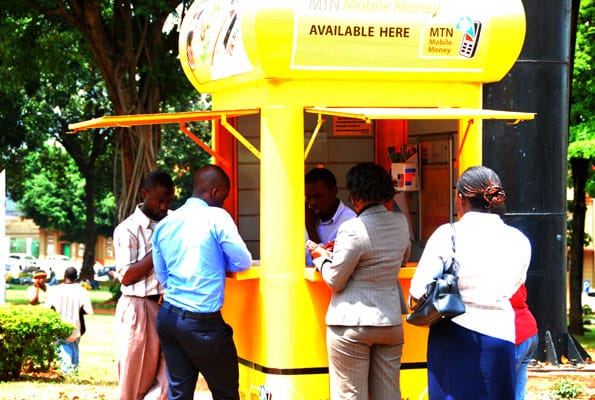
- Install branding materials provided by the telecom provider (umbrellas, booths, banners).
- Ensure you have a safe cash storage method and consider hiring security in very busy areas.
4. Float and Equipment
- Float is the digital money you use for transactions. Providers usually require an initial deposit of UGX 2M–5M.
- Basic equipment includes:
- Mobile phone(s) with SIM cards registered for the agency
- Agent lines from MTN/Airtel
- Record books or digital POS system
- A reliable power source for charging
5. Operations and Customer Service
- Offer key services: deposits, withdrawals, bill payments, airtime sales, school fees payments, and money transfers.
- Train staff on fraud prevention, customer handling, and accurate record-keeping.
- Build trust — customers prefer agents who are reliable, polite, and efficient.
Mobile Money Agent Startup Costs in Uganda
| Item | Estimated Cost (UGX) |
| Kiosk/booth rent & deposit | 1,200,000 |
| Furniture & branding setup | 800,000 |
| Float (initial working capital) | 5,000,000 |
| Mobile phones & SIM cards | 700,000 |
| Licenses & permits | 500,000 |
| Marketing & signage | 300,000 |
| Staff salaries (1 month float) | 600,000 |
| Security & safes | 1,000,000 |
| Miscellaneous expenses | 400,000 |
| Total Startup Cost | 10,500,000 |
👉 Related reading Poultry Farming Business Plan: Startup Costs & Profits
Financial Projections: Mobile Money Agent Profits in Uganda
Assume 50 transactions per day at an average commission of UGX 1,000:
| Revenue/Expense | Monthly (UGX) | Annual (UGX) |
| Transaction commissions (50 × 1,000 × 30) | 1,500,000 | 18,000,000 |
| Airtime sales profit | 300,000 | 3,600,000 |
| Bill payment commissions | 200,000 | 2,400,000 |
| Total Revenue | 2,000,000 | 24,000,000 |
| Rent & utilities | -500,000 | -6,000,000 |
| Staff salaries | -600,000 | -7,200,000 |
| Security & misc. | -400,000 | -4,800,000 |
| Net Profit | 500,000 | 6,000,000 |
👉 With more transactions (100+ daily), profits can rise to over UGX 1.5M per month.
MTN vs Airtel vs M-Pesa Agent commission comparison
| Transaction amount (UGX) | MTN Mobile Money — Agent commission (typical) | Airtel Money — Agent commission (typical) | M-Pesa / Safaricom — Agent commission (reference / Kenya rates) |
| UGX 5,000 | Cash-out: ~UGX 440 (band 2,501–5,000 shows UGX 440). Cash-in: small deposit commissions vary (agent deposit often smaller). | Cash-out: ~UGX 100–150 (Airtel tiers are low at small amounts; see Airtel tariff bands). Cash-in: small. | Cash-out (Kenya ref): ~KSh 29 ≈ UGX 300 for very small withdrawals in Kenya; agent commission bands vary — confirm locally. (M-Pesa country differences apply.) |
| UGX 20,000 | Cash-out: ~UGX 700–880 (MTN band 5,001–15,000 then 15,001–30,000 shows ~UGX 700–880). Agent deposit: banded—agent commission on deposits exists per provider terms. | Cash-out: ~UGX 100–400 depending on Airtel band (see Airtel tariff guide). Agent deposit: banded. | Cash-out (Kenya ref): ~KSh 52–87 ≈ UGX 600–1,000 (varies by band). Use Kenya M-Pesa bands only as rough proxy; verify Uganda specifics. |
| UGX 50,000 | Cash-out: ~UGX 1,210–1,500 or more depending on band (MTN shows ~UGX 1,210 for 30k–45k, UGX 1,500 for 45k–60k). | Cash-out: ~UGX 400–1,200 depending on Airtel band — tiered. | Cash-out (Kenya ref): ~KSh 87–171 ≈ UGX 1,000–2,000 (agent commission on larger withdrawals increases). Confirm local M-Pesa/Uganda tables. |
| UGX 200,000 | Cash-out: ~UGX 3,575–7,000 (MTN mid/high bands show several-thousand UGX agent fees for big withdrawals). Agent deposit commissions also rise on large amounts. | Cash-out: ~UGX 1,200–5,000 (Airtel banded charges/agent shares; see Airtel tariff guide. | Cash-out (Kenya ref): higher fixed commissions in upper bands (example: several hundred KSh); use Kenyan M-Pesa bands only as a guide. |
| UGX 1,000,000 | Cash-out: ~UGX 12,500–20,000+ (MTN shows large-amount agent withdraw bands in this range). Big transactions have proportionally larger agent fees. | Cash-out: higher band fees (several thousand UGX) — Airtel publishes banded tables. | Cash-out (Kenya ref): largest bands have highest commissions; Safaricom publishes explicit agent commission tables for Kenya — apply with caution outside Kenya. |
Risks Challenges, and Tips for Success
Risks
- Fraud & Scams: Fake notes, SIM swap fraud, and social engineering.
- Robbery: Cash handling increases risk in unsafe areas.
- Float Shortages: Low float means lost customers and commissions.
Tips for Success
- Keep balanced float (both cash and digital money).
- Invest in security (safes, CCTV, trusted staff).
- Diversify services: add airtime sales, pay-TV bill payments, and even retail items.
- Build customer loyalty through reliability and small value-adds (like shade/seating).
How much capital do I need to start a mobile money business in Uganda?
On average, UGX 10–15 million is needed to start, including float, kiosk, equipment, and licenses.
Which mobile money service is most profitable in Uganda?
MTN and Airtel dominate the market. Profits depend on transaction volume in your area — in rural areas, Airtel may lead, while in urban centers, MTN often has more users.
How do mobile money agents in Uganda make money?
Agents earn commissions on deposits, withdrawals, airtime sales, and bill payments. Higher transaction volumes = higher profits.
Is mobile money agent business risky?
Yes. The main risks are fraud, robbery, and float shortages. Strong security measures and training can minimize these risks.
Can I operate multiple mobile money outlets?
Yes. Many successful agents operate several kiosks or shops across busy trading centers. This scales profits and brand recognition.
Conclusion: Should You Start a Mobile Money Business in Uganda?
Yes. A mobile money agency is one of the most profitable small businesses in Uganda in 2025, with consistent customer demand and solid commissions. With startup costs of around UGX 10.5M and realistic profits of UGX 500,000–1.5M monthly, it’s an attractive opportunity for entrepreneurs.
External Resources: