NSSF Rates in Kenya 2026: How Much You Pay, Checking Your Balance and Claiming
NSSF takes 6% of your pay, up to KES 6,480, matched by your employer -- KES 12,960 combined under Kenya's Year 4 rates. Checked October 2026.

In this guide▾
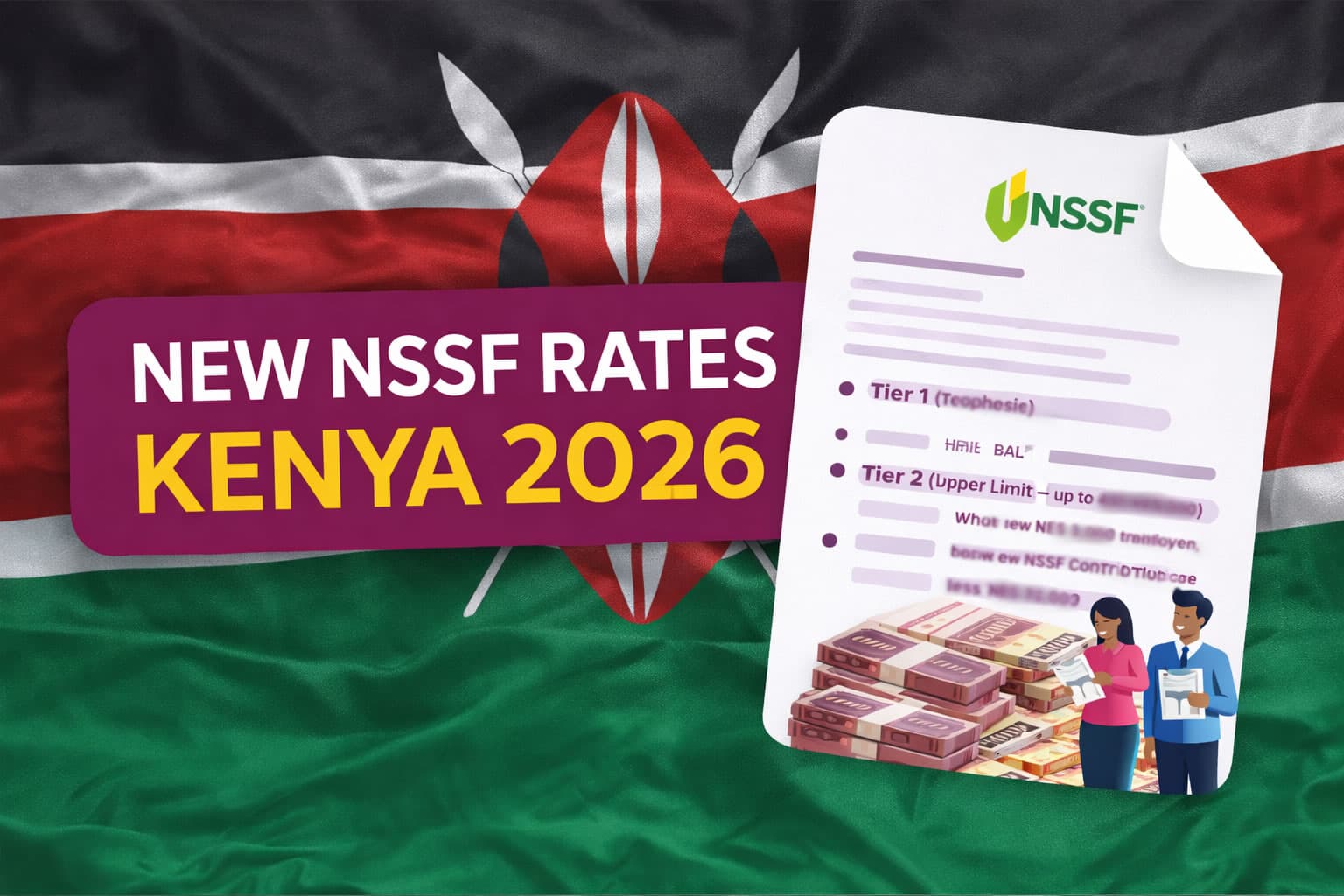
As of October 2026, NSSF takes 6% of your pay from you and another 6% from your employer, up to a combined KES 12,960 a month. These are the Year 4 rates under the National Social Security Fund Act, which took effect in February 2026: you pay 6% on the first KES 9,000 you earn (Tier I), then 6% again on everything between KES 9,000 and the KES 108,000 upper limit (Tier II). Earn KES 108,000 or more and your own deduction tops out at KES 6,480 a month, matched by another KES 6,480 from your employer, as set out in NSSF's official notice to employers published in February 2026.
Quick facts: NSSF rates 2026
| Tier I (up to KES 9,000) | Tier II (KES 9,000–108,000) | Total | |
|---|---|---|---|
| Rate | 6% of lower limit | 6% of the band above the lower limit | — |
| Max you pay | KES 540 | KES 5,940 | KES 6,480 |
| Max your employer pays | KES 540 | KES 5,940 | KES 6,480 |
| Max combined | KES 1,080 | KES 11,880 | KES 12,960 |
Source: NSSF Year 4 (2026) Contribution Rates notice, checked October 2026.
How much is NSSF per month in 2026?
NSSF works in two tiers, and most of the confusion online comes from people mixing them up.
Tier I covers the first KES 9,000 of your gross pay. You pay 6% of that (KES 540), and your employer pays a matching KES 540. Everyone who earns at least KES 9,000 hits this cap.
Tier II covers the portion of your pay between KES 9,000 and KES 108,000. You pay 6% of whatever falls in that band, and so does your employer, up to a maximum of KES 5,940 each once you earn KES 108,000 or more.
Add the two tiers together and the most that can come off your payslip for NSSF is KES 6,480 a month, with your employer putting in the same amount on top. That's up from a combined maximum of KES 8,640 under the old KES 72,000 upper limit — the Year 4 rates roughly doubled what high earners contribute.
A few worked examples, using the 6% rate on each band:
| Gross monthly pay | Tier I (you pay) | Tier II (you pay) | Total you pay | Employer matches |
|---|---|---|---|---|
| KES 9,000 or less | 6% of your pay | 0 | Up to KES 540 | Same |
| KES 25,000 | 540 | 6% × (25,000 − 9,000) = 960 | 1,500 | 1,500 |
| KES 45,000 | 540 | 6% × (45,000 − 9,000) = 2,160 | 2,700 | 2,700 |
| KES 80,000 | 540 | 6% × (80,000 − 9,000) = 4,260 | 4,800 | 4,800 |
| KES 108,000 or more | 540 | 5,940 (capped) | 6,480 | 6,480 |
Want your exact figures without doing the maths yourself? Run your gross pay through our NSSF calculator for an instant Tier I and Tier II breakdown.
Say you're an accounts clerk in Nakuru earning KES 45,000 a month. Your payslip shows KES 2,700 going to NSSF, and your employer sends another KES 2,700 on your behalf — KES 5,400 landing in your account every month. NSSF is only one of several deductions on that payslip; our guide to PAYE in Kenya breaks down the rest, or run the whole thing through our Kenya PAYE calculator, which works out NSSF, SHIF and the housing levy together. For the SHIF side specifically — rates, SHA registration and paying via M-Pesa — see our SHIF contributions guide.
Your NSSF contributions earn interest every year — the Fund declared 17% net interest for the 2024/2025 contribution year at its 8th Annual General Meeting on 6 February 2026, credited to members' accounts on top of what they've paid in, according to the same official notice.
Is NSSF mandatory, and who registers you?
Yes. Under the NSSF Act, every employer in Kenya must register with the Fund and deduct NSSF from every employee's pay, and the Fund confirms on its FAQ page that "all employers must register with NSSF." You don't register yourself as an employed member in most cases — you go to the nearest NSSF office with your employer's introduction letter and your national ID (or alien card or passport) plus a copy, and NSSF issues your membership card and number there and then, according to NSSF's page for employed members. You then hand that NSSF number to your employer, who uses it to remit your contributions.
If you're self-employed, freelancing, or running a side hustle with no formal employer, you can still join as a voluntary member. Visit an NSSF branch with your ID and a copy, and a minimum first contribution of KES 200 activates your membership, per NSSF's voluntary member page. After that, you top up whenever you like by dialling *222# on your phone and paying through M-Pesa — useful if your income is irregular and you'd rather contribute KES 1,000 one month and nothing the next than commit to a fixed salary deduction.
That includes house helps and nannies. Our house help salary calculator works out both your share and theirs, and makes monthly payslips.
How to check your NSSF balance
You have four ways to see how much you've contributed, none of which should cost you anything:
- NSSF Self-Service Portal. Register once at selfservice.nssf.or.ke with your NSSF number and ID, then log in any time to view your contributions statement.
- NSSF Mobile Application. The same portal links to an NSSF Mobile App guide for checking your statement from your phone.
- Free statement on request. NSSF's FAQ page states plainly: "NSSF will issue you with a FREE statement of account on demand," showing your contributions and the interest they've earned — ask at any branch or through the channels below.
- Phone and WhatsApp. NSSF's contact page lists +254 704 303 303 as a WhatsApp line, and the Fund's toll-free number is 0800 2212744, per the FAQ page. The Fund's February 2026 notice also lists
*303#to dial directly for NSSF services.
Don't pay anyone who promises to fast-track or release your NSSF statement for a fee — every official channel above is free.
How to claim your NSSF benefits
NSSF pays out under five benefit categories, each with its own age or eligibility rule and its own documents. This is straight from NSSF's benefits page, checked October 2026:
| Benefit | Who qualifies | Core documents |
|---|---|---|
| Age/Retirement Benefit | You reach 55, or you retire from regular employment | Certified retirement letter, certificate of service or termination letter; membership card; ID/passport/alien ID; bank details for EFT |
| Withdrawal Benefit | You're at least 50 and have left regular paid employment | Same as above |
| Survivors Benefit | Paid to a deceased member's dependants, in order: spouse, children, parents, siblings, guardian of minor children, then an administrator | Original death certificate; copy of deceased's ID; claimant's ID; County Administration letter confirming dependants; deceased's NSSF number |
| Invalidity Benefit | You're permanently unable to work due to physical or mental disability (or 50+ with a permanent partial incapacity) | Membership card; ID; certified retirement/medical termination letter; medical report from your treating hospital; bank details |
| Emigration Benefit | You're leaving Kenya for a non-EAC country for good | Membership card; ID or passport; certified termination letter; visa; sworn affidavit of permanent emigration (citizens) or travel ticket (non-citizens) |
All five are filed in person at an NSSF branch — application forms are available to download from the NSSF website, but the Fund still processes the claim at a physical office rather than fully online. If you're claiming a retirement or withdrawal benefit, it also helps to have your KRA PIN ready, since NSSF payouts can affect your tax position.
What to watch out for
- Don't confuse the "6,480" and "5,940" figures. Some guides quote KES 6,480 as the Tier II maximum alone — it isn't. KES 5,940 is the most you pay on Tier II; KES 6,480 is your Tier I and Tier II combined.
- You can't touch your NSSF before 50, except through specific hardship provisions handled case-by-case at a branch. If you need cash sooner, a top SACCO deposit or a treasury bill gives you access without waiting for retirement.
- Keep your NSSF number safe. You'll need it for every claim, every statement request and every new job. Losing your card means a trip to a branch to recover it.
- Self-employed and only earning occasionally? The KES 200 voluntary membership minimum is low on purpose — it's worth activating even if you can't contribute every month, because your balance still earns NSSF's declared interest rate once it's in. Pairing it with one of the best digital savings apps in Kenya covers the months you'd rather not touch NSSF at all.
Frequently asked questions
How much is NSSF per month in Kenya in 2026?
Between KES 540 (if you earn KES 9,000 or less) and KES 6,480 (if you earn KES 108,000 or more) a month, under the Year 4 rates effective February 2026. Your employer pays a matching amount on top, so the combined contribution tops out at KES 12,960 a month per employee.
What's the difference between NSSF Tier I and Tier II?
Tier I is 6% of your first KES 9,000 of pay, capped at KES 540. Tier II is 6% of whatever you earn between KES 9,000 and KES 108,000, capped at KES 5,940. Both are deducted from the same payslip and remitted together.
Is NSSF compulsory for every employee in Kenya?
Yes. Every registered employer must deduct and remit NSSF for every employee under the NSSF Act. You can't opt out of employed membership, though the amount you pay depends entirely on your salary.
How do I check my NSSF balance without going to a branch?
Register on the NSSF Self-Service Portal to view your contributions statement online, use the NSSF Mobile App, or dial *303# for NSSF services on your phone.
Can I withdraw my NSSF before I turn 50?
Not under the standard Withdrawal Benefit, which requires you to be at least 50 and no longer in regular paid employment. Before that age, your contributions stay locked in and keep earning NSSF's declared annual interest — 17% for the 2024/2025 year.
I'm self-employed — can I still contribute to NSSF?
Yes, as a voluntary member. Visit an NSSF branch with your ID to register, pay a minimum first contribution of KES 200, then top up whenever you like by dialling *222# and paying via M-Pesa.
Keep reading

KRA Tax Amnesty 2026: Who Qualifies, the December Deadline and How to Apply
KRA is waiving 100% of penalties and interest on tax debts to December 2025 under its 2026 amnesty, but not the principal tax. Who qualifies and how to apply.
22 Oct 2026 · 7 min read

How to Get Your M-Pesa Statement (2026): *334#, App, Password and Excel
How to get your M-Pesa statement on *334# or the M-PESA app, where the password comes from, what to do if it won't open, and how to use it for a loan, your KRA return or a budget.
20 Oct 2026 · 5 min read
How to Register a Chama in Kenya (2026): Requirements, Fees and Steps
How to register a chama as a community group under the Community Groups Registration Act, 2022: who qualifies, the documents, the 2026 fees, step-by-step process, and what a registered chama must do afterwards.
20 Oct 2026 · 5 min read