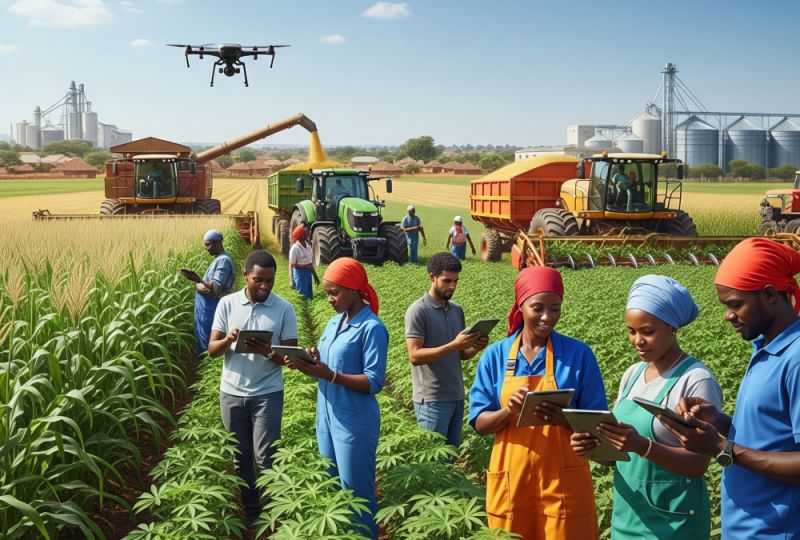
Uganda continues to emerge as a strong destination for investors, both domestic and foreign, due to its young population, improving infrastructure, and government policies that encourage value addition, public-private partnerships, and sector diversification.
In 2025, some of the most profitable investment opportunities Uganda offers are across agribusiness, energy, real estate, manufacturing, oil & gas, technology, and infrastructure.
Profitable Investment Opportunities Uganda
Below are the top 10 investment opportunities in Uganda, with concrete potentials, risks, and practical advice.
1. Agriculture & Agro-Processing
Agriculture remains the backbone of Uganda’s economy, contributing substantially to GDP, employment, and exports.
However, raw export of agricultural produce often yields lower returns compared to value addition.
Profitability increases when you move downstream: processing, packaging, cold storage, and exporting finished or semi-finished products.
Some promising sub-areas:
- Dairy & milk processing: New initiatives (e.g. Hand in Hand) are scaling UHT milk, yoghurt, milk powder production.
- Maize & cereals: Improving cleaning, storage, and processing (e.g. starch, oil) can reduce wastage and fetch higher margins.
- Leather & shoe goods: Uganda has a hides/skins base, but value addition (tanneries, finished leather goods) is underdeveloped.
- Export crops & high-value foods: Coffee (especially specialty), vanilla, cocoa, fruits, dried fruits.
Why profitable: The Ugandan government is supporting agribusiness investments via incentives; local/rural producers often under-served; global demand for processed food/agricultural products remains strong. Returns can be high (IRRs over 20-30% in some value added agribusiness investments).
Risks & cautions: Infrastructure (roads, electricity, storage) in Uganda is still weak in many rural areas; post-harvest losses; supply chain and logistics issues; price volatility; weather/climate risk.
2. Renewable Energy / Power Generation
Meeting Uganda’s rising electricity demand is a critical priority. Urbanization, industrial growth, and rural electrification all drive demand.
Investment opportunities in Uganda in solar, mini-hydro, grid extension, and off-grid solutions are increasing.
- Solar projects: e.g. Ituka Solar Power Station (24 MW solar PV), Xsabo Lira Solarline (50 MW) are among recent/ongoing ones.
- Small hydroelectric plants: new small/mini hydro stations to serve local demand.
- Large hydropower & grid capacity expansion: Uganda is seeking funds to build more hydro plants (Ayago, Kiba, Oriang etc) to add ~1,600 MW.
Why profitable: Strong demand; government willing to enter PPPs; incentives; possibility to sell to national grid; export potential in some cases.
Risks & cautions: Upfront capital cost is high; regulatory risk; power purchase agreements, delays; environmental/social approvals can slow down projects.
3. Oil & Gas and Associated Infrastructure
Uganda is in advanced stages of oil field development (Tilenga, Kingfisher) and planning a large oil refinery (estimated cost ~$4 billion), pipelines, storage, and related infrastructure.
Other associated opportunities include logistics (transport of materials), services (engineering, maintenance), pipeline construction, storage terminals, refining and downstream products like LPG, kerosene.
Why profitable: Major capital investment; government commitments; potential long-term stable returns; possibility to add value domestically rather than relying purely on crude exports.
Risks & cautions: Geopolitical risk; environmental concerns; fluctuating global oil prices; large capex and long horizon; regulatory, land acquisition and local community issues.
4. Real Estate & Affordable Housing
Urbanization is accelerating in Uganda. Cities like Kampala, Entebbe, Wakiso, Mukono are expanding rapidly.
This means there is a growing demand for real estate investment in Uganda for affordable and middle-income housing, commercial space, industrial parks.
- Affordable housing in peri-urban/suburban areas offers strong returns.
- Commercial real estate: offices, retail, mixed use in growing towns.
- Tourism related properties: lodges, hotels near national parks or tourist sites
Why profitable: Demand outpacing supply; land prices still rising; rental yields good in good locations; government putting infrastructure in new suburbs.
Risks & cautions: Currency depreciation (affecting cost of imported materials); high cost of capital; zoning and permitting; delays; oversupply risk in non-prime areas.
5. Manufacturing and Value Addition / Import Substitution
Uganda’s National Development Plan and Uganda Investment Authority have identified manufacturing, especially export-oriented and import-substituting industries, as priorities.
Potential areas include: Food & beverage processing, Textile and apparel, Pharmaceuticals, Leather and footwear, and Construction materials (cement products, tiles, steel)
Benefits from proximity to raw materials, labor supply, preferential trade access to regional blocs (EAC, COMESA).
Why profitable: Reduces dependence on imports; helps balance trade; government incentives; potential for export markets; value addition increases margins.
Risks & cautions: Infrastructure (power, water), supply of skilled labor, consistency of raw materials, competition from imports, regulatory / quality standards for exports.
6. Infrastructure & Transport
As Uganda builds out its infrastructure to support growth, many investment opportunities arise. Transport, logistics, ports, roads, rail, and airports are major priorities.
- Transport services & logistics businesses (warehousing, cold chain, cargo transit)
- Road construction and maintenance contracts
- Rail and airport upgrades
These are often done via public-private partnerships. The Ugandan government, through the Uganda Investment Authority, is keen on industrial parks and special economic zones, which require connecting infrastructure
Why profitable: High demand; large budget allocations; multiplier effect; attractiveness to investors who can deliver reliably.
Risks & cautions: Project delays; political risk; cost overruns; land acquisition; competition among bidders; need for regulatory stability.
7. ICT, Fintech & Digital Services
Uganda’s young, mobile-connected population and rising smartphone penetration make digital services a growing market.
Key opportunities include:
- Fintech (mobile payments, micro-lending, digital money apps)
- E-commerce, delivery logistics
- EdTech / online learning platforms
- AgriTech (digital tools for farmers)
With Uganda’s young population and increasing smartphone penetration, ICT and fintech are booming sectors. Areas include mobile payments, e-commerce, AgriTech, and EdTech. Several AgriTech investors in Uganda are already backing startups.
Why profitable: Low marginal cost for scaling; high potential growth; ability to reach under-served segments; possibility of backing or partnerships with international investors.
Risks & cautions: Regulatory risk around financial services; cybersecurity concerns; payment infrastructure; competition; access to capital; affordability & internet access in rural areas.
8. Tourism & Ecotourism
Uganda’s natural assets (national parks, gorillas, lakes, mountains) continue to attract tourists. Post-COVID, there is recovery and growth in outbound & inbound travel, especially from Africa and Europe.
Opportunities include creation or upgrade of lodging (lodges, boutique hotels), tour operations, transport to tourist sites, cultural tourism, conservation projects, and ecotourism.
Why profitable: Tourism tends to have high margins for certain types of lodging; unique assets (gorillas, wilderness) have global cachet; supportive policy; potential for foreign exchange earnings.
Risks & cautions: Sensitivity to global travel trends; political stability; infrastructure (roads, power, water) in remote tourism zones; environmental sustainability; seasonality; malaria/health risks for visitors.
9. Minerals & Mining/Value Chain
Uganda is rich in under-exploited mineral resources: gold, tin, tungsten, phosphates, rare earths, clay, silica sand, iron ore etc.
Mining itself can be profitable, but perhaps more immediately profitable is by adding value locally: processing, refining, producing minerals for local industrial use (cement, glass, electronics) rather than exporting raw ore.
Why profitable: Global prices for strategic minerals are high; supply constraints elsewhere; government interest in value addition; export potential.
Risks & cautions: Environmental issues; regulatory hurdles; access to capital; community issues; commodity price volatility; need for technical expertise.
10. Real Assets & Alternative Investments
This category includes land banking, forestry, carbon credits, and special investment vehicles like unit trusts / private equity / impact investment that target underserved or future-growth areas.
- Land investment: owning land in fast-growing suburban areas or in locations expected to become infrastructural hubs.
- Forestry & sustainable timber: for both local consumption and carbon offset markets.
- Carbon credits / environmental projects: e.g. conservation, reforestation.
Why profitable: Land prices tend to rise; as Uganda urbanizes, land close to infrastructure gets highly valued; increasing global demand for carbon credits; alternative investments may hedge inflation.
Risks & cautions: Land title risk; regulation of land ownership; long holding period; risk of property taxation changes; environmental regulation; liquidity is often low.
How to Choose Investment Opportunities in Uganda
To decide which of these profitable investment opportunities Uganda 2025 is best for you, here are factors and steps:
- Capital availability & risk tolerance: Some investments require high upfront investment and are long-term (oil/refinery, large solar, hydropower, large infrastructure). Others can be started with moderate capital (agro-processing, real estate in suburbs, ICT).
- Local knowledge and partnerships: Working with local communities, regulatory bodies (including Uganda Investment Authority), and understanding land laws, title, environmental laws is critical.
- Value addition vs raw export: Generally, adding value locally yields higher margins and less exposure to global commodity price swings.
- Regulatory environment and incentives: Be aware of tax breaks, investment licences (for example UIA license thresholds), export incentives, PPP frameworks.
- Infrastructure and logistics: Does the area have good roads, power, water, connectivity? These can make or break profitability.
- Market access and demand: Local population growth, export demand, regional trade (EAC, COMESA), diaspora markets.
- Sustainability and ESG: Environment, community impact, climate risk — increasingly important for investors, both local and foreign.
Popular Investment Opportunities: Summary Table
| Investment Opportunity | Why It’s Profitable in 2025 | Key Requirements / Entry Barriers | Suitable Investor Types |
|---|---|---|---|
| Agriculture & Agro-Processing | High demand; government support; export markets; value addition raises margins | Land, access to inputs, cold storage, logistics, quality standards | Medium / large investors; cooperatives; agripreneurs |
| Renewable Energy / Power Generation | Growing electricity demand; solar & small hydro projects being incentivized | High CAPEX; regulatory approvals; PPA arrangements; environmental impact assessments | Project developers; energy companies; infrastructure funds |
| Oil & Gas / Refinery & Infrastructure | Huge potential downstream returns; strategic national project; job creation | Very large capital, long payback; regulatory/policy risk; global oil price volatility | Large corporations; foreign investors; strategic partners |
| Real Estate & Affordable Housing | Urbanization; housing deficit; rising rents; demand for commercial space | Land acquisition; cost of materials; regulatory/permits; financing interest rates | Real estate developers; REITs; local investors; diaspora |
| Manufacturing / Value Addition | Import substitution; regional trade; raw material availability; high margin products | Skilled labor; power, water, inputs; quality control; market access | Manufacturers; joint ventures; export-oriented firms |
| Infrastructure & Transport | Government priority; multiplier effect; improving trade flows; corridors | Large scale funding; long timelines; land issues; political risk | PPP investors; infrastructure funds; contractors |
| ICT, Fintech & Digital Services | Young population; under-served markets; scalable; mobile penetration rising | Regulatory supervision; infrastructure for connectivity; digital literacy; competition | Tech startups; venture capital; impact investors |
| Tourism & Ecotourism | Unique attractions; recovery of global travel; foreign currency earnings | Infrastructure in remote areas; marketing; health & safety; seasonality | Hoteliers; tour operators; eco / conservation investors |
| Minerals & Mining / Value Chain | Rich natural resources; export and industrial demand; value addition opportunities | Environmental/social license; regulatory compliance; price volatility; transport costs | Mining firms; downstream processors; investors with technical capacity |
| Real Assets & Alternative Investments | Land value appreciation; carbon markets; diversification; inflation hedge | Land title issues; long holding periods; illiquidity; regulatory risk | Land developers; environmental funds; impact investors; high net worth individuals |
Conclusion
Uganda presents several profitable investment opportunities in 2025.
For investors seeking high returns, agriculture with value addition, renewable energy, oil & gas infrastructure, and real estate/affordable housing often offer the best risk-/return balance.
Meanwhile, sectors like ICT, tourism, minerals, and alternative investments offer diversification, perhaps higher risk but with strong upside.
Choosing the right opportunity depends heavily on your capital, risk tolerance, local presence, partnerships, and ability to navigate Uganda’s regulatory and infrastructural landscape. For best results, combine a clear understanding of market demand with value addition, local resource leverage, and sustainable practices.